REVIEW · MYKONOS
DELOS, the island of god Apollo
Book on Viator →Operated by Delos Private Tours · Bookable on Viator
One of the most haunting ruins in Greece starts with a boat. A private half-day excursion to Delos turns Mykonos into something bigger: myth, commerce, and archaeology in the same compact visit. You’ll get a guide who links the stones to the stories, plus the comfort of hotel pickup and drop-off.
My favorite part is how much ground you cover without feeling rushed. In about 4.5 hours you see the theater district, the main theater, and the sanctuary of Apollo—including the spots people point to as Apollo’s birthplace. I also really like that this is private, so your group can move at a pace that actually works for your questions.
One thing to plan for: Delos involves walking on uneven ground and archaeological surfaces. It’s not recommended if you have walking problems, and even if you’re only moderately mobile, you’ll want good shoes and realistic expectations.
In This Review
- Key things to know before you book
- Delos From the Start: Why This “Myth Island” Feels Different
- Hotel Pickup + Private Transportation: More Time for Delos, Less Time for Hassle
- The Timing: A Realistic Half Day on a Busy Island Schedule
- Stop 1 on Delos: Theater District First, for the Best Preserved Views
- Stop 2: The Ancient Theater and What 6,500 People Means
- Stop 3: Apollo’s Sanctuary, the Birthplace Spot, Marble Lions, and the Slave Market
- The Role of Your Guide: When a Teacher Makes the Ruins Click
- Price and Value: What You Pay, What You Don’t
- Mobility and Comfort: What to Plan for on Delos
- Who This Tour Fits Best (and Who Might Skip Delos Today)
- Quick Practical Tips Before Your 9:00 am Departure
- Should You Book Delos Private Tours?
- FAQ
- What time does the Delos tour start?
- Does the tour include hotel pickup and drop-off?
- Is this a private tour?
- How long is the tour?
- What language is the tour guide?
- What’s included in the price?
- What’s not included for the trip to Delos?
- Is Delos suitable if I have walking problems?
Key things to know before you book
- Private group tour (up to 6): only your group participates, with guide time tailored to you.
- Half-day timing: about 4 hours 30 minutes starting at 9:00 am, which is perfect for fitting into a Mykonos schedule.
- Three signature zones: theater district mosaics and cisterns, the theater seating area, and Apollo’s sanctuary plus marble lions.
- Ferry and entrances extra: budget about €45 per person for ferry tickets and entrances.
- You’ll need basic mobility: moderate fitness is required; walking issues make it a poor match.
- Guide quality matters here: a strong guide can be the difference between seeing ruins and understanding why they mattered.
Delos From the Start: Why This “Myth Island” Feels Different
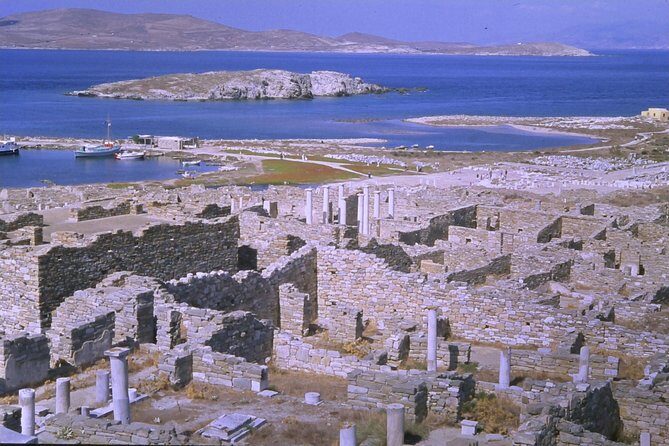
Delos is often described as an archaeological site, but that label doesn’t fully capture its punch. This place was a religious center tied to Apollo, yes—but it also became a trading hub that grew rich through the slave market. When you visit, you don’t just look at temples and theaters. You also see how power, worship, and profit were tangled together.
That mix is exactly why I like this kind of structured, guided visit. Without explanation, you can end up reading plaques like a chore. With the right guide, you start linking the theater to performances, the Apollo sanctuary to myth, and the layout to how Delos functioned day-to-day.
And because the tour is half-day, you’re not spending your whole vacation hauling your attention across a long itinerary. You get the core highlights with enough context to make it feel coherent.
Other Delos and Rhenia cruises we've reviewed in Mykonos


Hotel Pickup + Private Transportation: More Time for Delos, Less Time for Hassle
Starting at 9:00 am, this tour includes pickup from your location. That matters on Mykonos, where getting organized can eat into your day fast. Instead of guessing routes, wrangling transfers, or trying to coordinate with others, you’re handed a simple plan: you’re collected, you’re transported, and you’re returned to where you started.
Private transportation also supports the biggest practical benefit of a private tour: flexibility. If your group needs a bathroom break, a slower pace, or time to regroup after a viewpoint, you can usually make that happen more smoothly than on large group departures.
The trade-off is the obvious one: you’re paying for the convenience. But with a group size of up to 6 people, the per-person value can feel more reasonable than tours priced like you’re traveling alone.
The Timing: A Realistic Half Day on a Busy Island Schedule
You’re looking at about 4 hours 30 minutes on the ground and around that time window overall. That pacing is useful because Delos is not a “stroll forever” kind of place. You’ll be in and out of key zones, and the guide will keep the story moving as you go.
This is also where the tour’s popularity matters. It’s commonly booked well in advance (about 125 days on average). If you’re traveling in peak season or you have a specific day you want Delos, it’s smart to book early rather than hoping a last-minute opening appears.
Also keep ferry time in mind. Even though you’re going for the archaeology, the sea portion is part of the experience. In practice, it can be the decompression period between the cruise-line pace of Mykonos and the dense, detailed ruins on Delos.
Stop 1 on Delos: Theater District First, for the Best Preserved Views
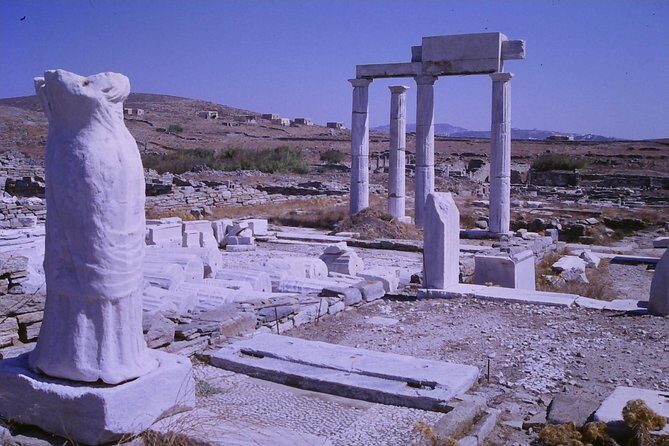
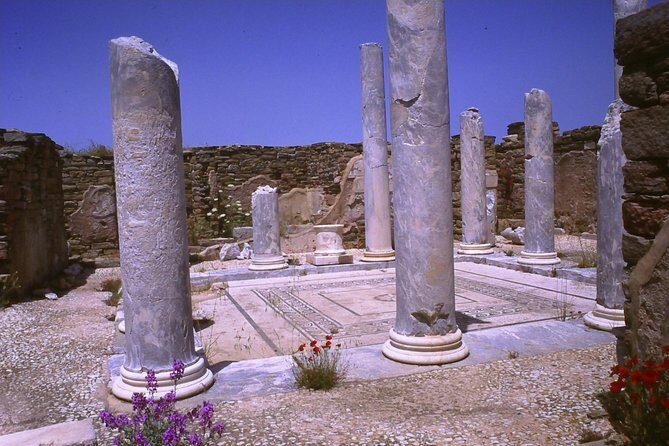
You begin at the Archaeological Site of Delos, focusing first on the theater district. This is a smart order. It’s often the best-preserved part of the ancient town, so you get a strong visual foundation before moving into more fragmented remains.
In this first stop, you’ll spend about 1 hour and see several standout features:
- The theater district layout, which helps you understand how the city was organized
- Different ancient houses
- Mosaic floors that show how ordinary life looked, not just ceremonial spaces
- Water cisterns, which are a quiet reminder that running a city required serious infrastructure
- Marble colonnades, which give you a sense of scale and wealth
What I like about starting here is that the guide can explain daily life and urban planning before jumping into the big myth moments. You start with a picture of the town, then you build upward.
Possible drawback: this area involves more active walking than you might expect. Even if the time on each stop is manageable, uneven ground is part of the deal at major Greek archaeological sites.
Stop 2: The Ancient Theater and What 6,500 People Means
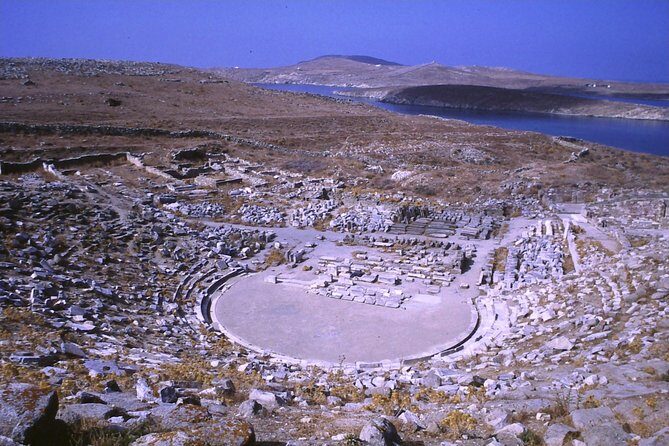
Next you move to the ancient theater, with about 30 minutes here. The theater once accommodated around 6,500 spectators, which is a huge number for an ancient Greek setting.
This is where the guide’s job gets especially important. The theater isn’t just a seating bowl. It’s tied to performances and the way stories were acted out in public. When you’re told what kinds of performances happened and how actors worked, you start picturing the space differently instead of treating it like a static monument.
This stop is shorter than the first one, but it’s a good “anchor moment” in the tour. After you’ve seen houses, mosaics, and urban features, the theater becomes the emotional headline—where religion and community life meet through performance.
Wear shoes you can trust. Stone steps and uneven surfaces are common around these theaters, and you’ll be glad you brought footwear with grip.



Stop 3: Apollo’s Sanctuary, the Birthplace Spot, Marble Lions, and the Slave Market
The final stop is the sanctuary of Apollo, with about 1 hour devoted to this area. It’s the heart of the myth connection, but the way this tour frames it keeps it grounded.
Here’s what you can expect to see:
- Remaining structures from Apollo’s temple
- What’s left of a gigantic statue
- The slave market area, with context about how Delos became wealthy through the slave trade
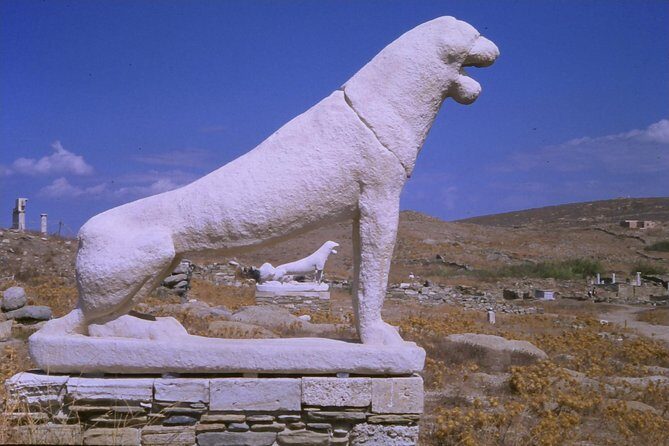
- The mythical birthplace spot of Apollo, marked and guarded by impressive marble lions
I appreciate the balance in this stop. Apollo is the headline, but the slave market context prevents the visit from becoming one-note religious sightseeing. Delos was a real place with real economic machinery, and that’s why it feels historically sharper than many other “ruins of a different era” stops.
One practical consideration: the sanctuary area can be emotionally heavy. The tour doesn’t just float through myth. It also addresses commerce tied to slavery. If that’s tough for you, go in with the mindset that this is part of understanding what Delos was.
The Role of Your Guide: When a Teacher Makes the Ruins Click
This is a tour where a strong guide really matters. The difference shows up fast when you can tell the guide is connecting architecture to meaning rather than reciting facts like a script.
One guide name that stands out from experience on this tour is Nicolaus, described as having a history teacher background. That kind of teaching style tends to work well on Delos because the site is complex. You want someone who can explain how things relate: why a cistern matters, what the theater implies about civic life, and why Apollo’s sanctuary sits where it does.
Bottom line: if you enjoy learning as you walk, you’ll likely find this tour hits the sweet spot. If you only want photos with minimal talking, you might feel the time is heavier than you hoped.
Price and Value: What You Pay, What You Don’t
The price is $1,056.21 per group (up to 6), and it lasts about 4 hours 30 minutes. That’s not “cheap,” but it’s also not priced like a solo VIP ride.
Where the value comes from:
- Private format: your group isn’t competing for attention with strangers
- Hotel pickup and drop-off
- Local guide focused on Delos’s specific story
What’s not included:
- Ferry tickets and entrances, around €45 per person
So you’re really paying for the package plus the “get there” cost. If you’re traveling as a small group, the tour can start to make more sense because the guide and transportation costs are shared across up to six people.
If you’re traveling solo, the math gets tougher. In that case, you’d want to be sure you’re truly going to use the guide time and enjoy the structured stops.
Mobility and Comfort: What to Plan for on Delos
Delos requires moderate physical fitness. It’s not recommended if you have walking problems. That’s because archaeological areas tend to include uneven surfaces, stone steps, and paths that aren’t designed for accessibility.
That said, I’ve also seen firsthand that people with mobility issues sometimes consider it worth it with the right support. One practical example from similar situations: at the Mykonos end of the ferry route, the pedestrian-only area can make the walking tougher at the end of the day. In at least one case, the driver coordinated help to get closer to the right area.
Here’s the sensible approach for you: if you have mobility concerns, plan on more walking than you think, and ask in advance what help is possible for your exact situation. Build buffer time into your schedule so you aren’t rushing at the end.
Who This Tour Fits Best (and Who Might Skip Delos Today)
I think this tour is a great fit if:
- You want Delos highlights without spending hours trying to figure things out on your own
- You like your archaeology with an explanation that connects myth, city life, and religion
- You’re traveling with up to five friends or family and want the calm of a private group
- You appreciate an early start that gives you a strong morning anchor before returning to Mykonos
I’d consider skipping or choosing something different if:
- You have significant walking limitations and don’t want to risk uneven ground
- You only want quick photo stops and don’t care about the meaning behind the sites
- Your schedule can’t handle an early 9:00 am departure window
Quick Practical Tips Before Your 9:00 am Departure
A few small choices make a big difference on Delos:
- Bring comfortable, grippy shoes for stone and uneven ground
- Dress for sun and wind. The day can feel cooler or sharper than Mykonos depending on conditions
- Keep expectations realistic: you’ll see major highlights, but you won’t be doing slow, museum-style wandering
- Bring a charged phone or camera, but count on the guide to help you locate what matters in the ruins
Also, since the ferry and entrances are extra, make sure you budget for that €45 per person. It’s easier to enjoy the tour when you’re not mentally doing math mid-day.
Finally, if plans change, there’s free cancellation up to 24 hours in advance for a full refund. That gives you some breathing room if weather or timing gets complicated.
Should You Book Delos Private Tours?
If you want the best odds of a meaningful Delos visit, I’d lean toward booking. This tour has a strong reputation (an average rating of 4.5 from 22 experiences), and the biggest theme in that kind of feedback is consistent: the guide experience matters.
I especially like that you get Apollo’s sanctuary, the theater, and the more human-scale theater district in a compact half-day format. That combination helps you understand Delos as more than a single myth stop. It’s a place where religion, performance, urban life, and harsh economics all show up in the same walk.
If your group size is up to six, you’ll also appreciate the private setup value. If you’re traveling solo or you’re very limited on mobility, you’ll need to weigh the cost and physical reality carefully.
If you fall in the middle—moderately mobile, curious, and craving context—this is an excellent way to do Delos without turning your day into a logistics puzzle.
FAQ
What time does the Delos tour start?
The tour starts at 9:00 am.
Does the tour include hotel pickup and drop-off?
Yes. Hotel pickup and drop-off are included, and the guide picks up travelers from their location.
Is this a private tour?
Yes. It’s a private tour/activity, and only your group will participate.
How long is the tour?
The duration is approximately 4 hours 30 minutes.
What language is the tour guide?
The tour is offered in English.
What’s included in the price?
Included are the tour guide and private transportation.
What’s not included for the trip to Delos?
You’ll need ferry tickets and entrances, which are listed as €45.00 per person and are not included.
Is Delos suitable if I have walking problems?
The tour requires moderate physical fitness and is not recommended for people with walking problems.